Thank you for attending my presentation.
Below you'll find the accompanying resources from my two presentations on PANS and Interoception.
I'd love to stay in touch. If you have any questions, comments, or feedback, please feel free to email me at [email protected].
I hope you're enjoying OT Exchange as much as I am. Feel free to come say hi after my talk!
Also, please page down to learn more about a special issue of the Q1 Journal Children that I am co-editing!
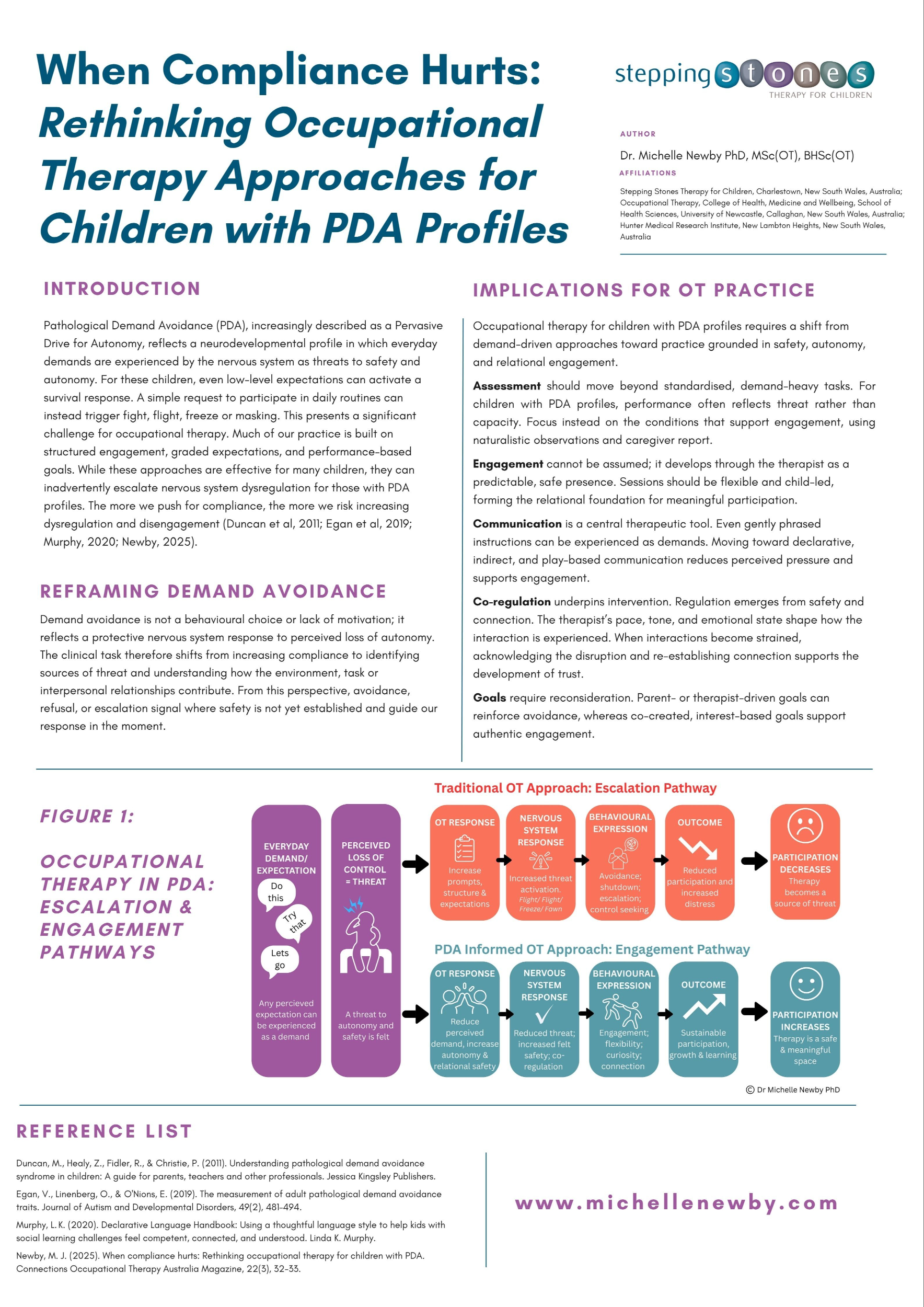
PS: Don't forget to check out my poster:
When Compliance Hurts: Rethinking Occupational Therapy Approaches for Children with PDA Profile
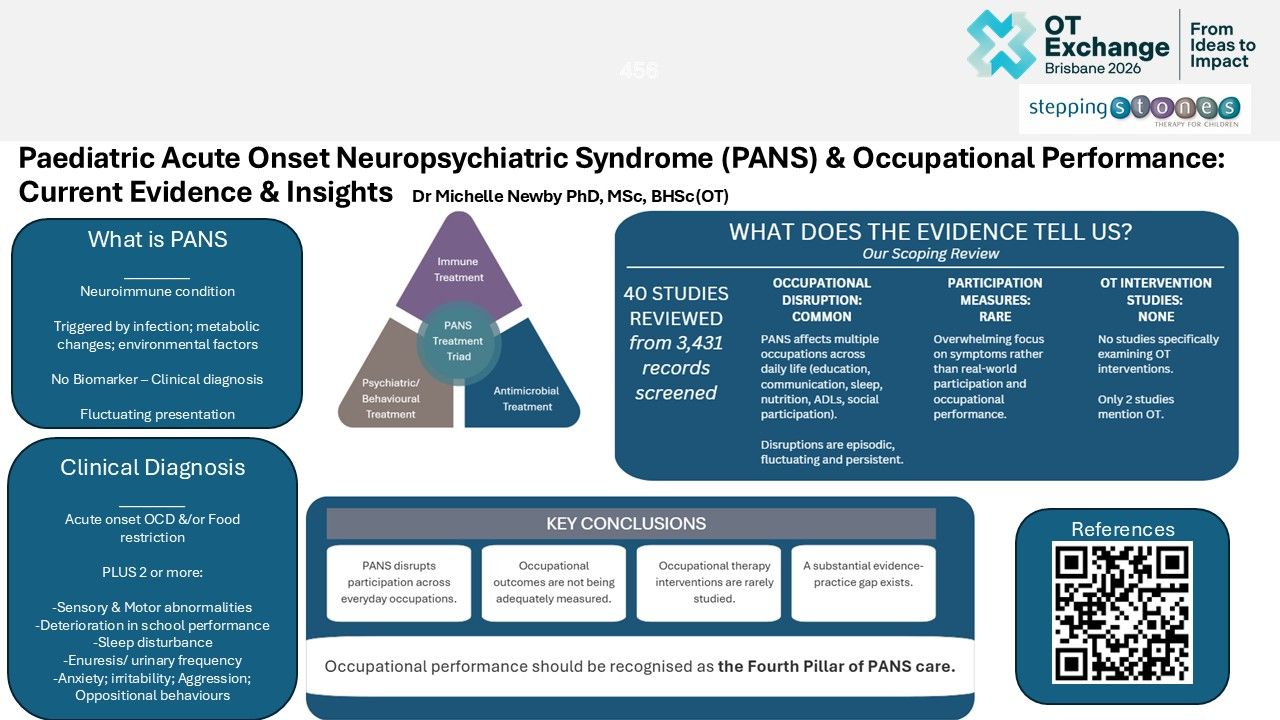
Paediatric Acute-onset Neuropsychiatric Syndrome (PANS) & Occupational Performance: Current Evidence & Insights
Reference list:
Frankovich, J., Swedo, S. E., Murphy, T., Dale, R. C., Agalliu, D., Williams, K., Daines, M., Hornig, M., Chugani, H., Sanger, T., Muscal, E., Pasternack, M., Cooperstock, M., Gans, H., Zhang, Y., Cunningham, M., Bernstein, G., Bromberg, R., Willett, T., Brown, K., Farhadian, B., Chang, K., Geller, D., Hernandez, J., Sherr, J., Shaw, R., Latimer, E., Leckman, J., Thienemann, M. (2017). Clinical management of pediatric acute-onset neuropsychiatric syndrome: Part II-use of immunomodulatory therapies. Journal of Child and Adolescent Psychopharmacology, 27(7), 574-593.
Newby, M. J., Haracz, K., Lane, S. J., & Tona, J. (2025). Pediatric acute-onset neuropsychiatric syndrome (PANS) and occupational performance: A scoping review. American Journal of Occupational Therapy, 79, 7906205050. https://doi.org/10.5014/ajot.2025.051238
Rea, I., Guido, C. A., & Spalice, A. (2021). Clinical Features in Patients With PANDAS/PANS and Therapeutic Approaches: A Retrospective Study. Frontiers in Neurology, 12, 741176–741176. https://doi.org/10.3389/fneur.2021.741176
Sigra, S., Hesselmark, E., & Bejerot, S. (2018). Treatment of PANDAS and PANS: a systematic review. Neuroscience and Biobehavioral Reviews, 86, 51–65. https://doi.org/10.1016/j.neubiorev.2018.01.001
Swedo, S., Leckman, J., & Rose, N. (2012). From Research Subgroup to Clinical Syndrome: Modifying the PANDAS Criteria to Describe PANS (Pediatric Acute-onset Neuropsychiatric Syndrome). Pediatrics & Therapeutics, 2(113).
Swedo, S. E., Frankovich, J., & Murphy, T. K. (2017). Overview of Treatment of Pediatric Acute-Onset Neuropsychiatric Syndrome. Journal of Child and Adolescent Psychopharmacology, 27(7), 562-565.
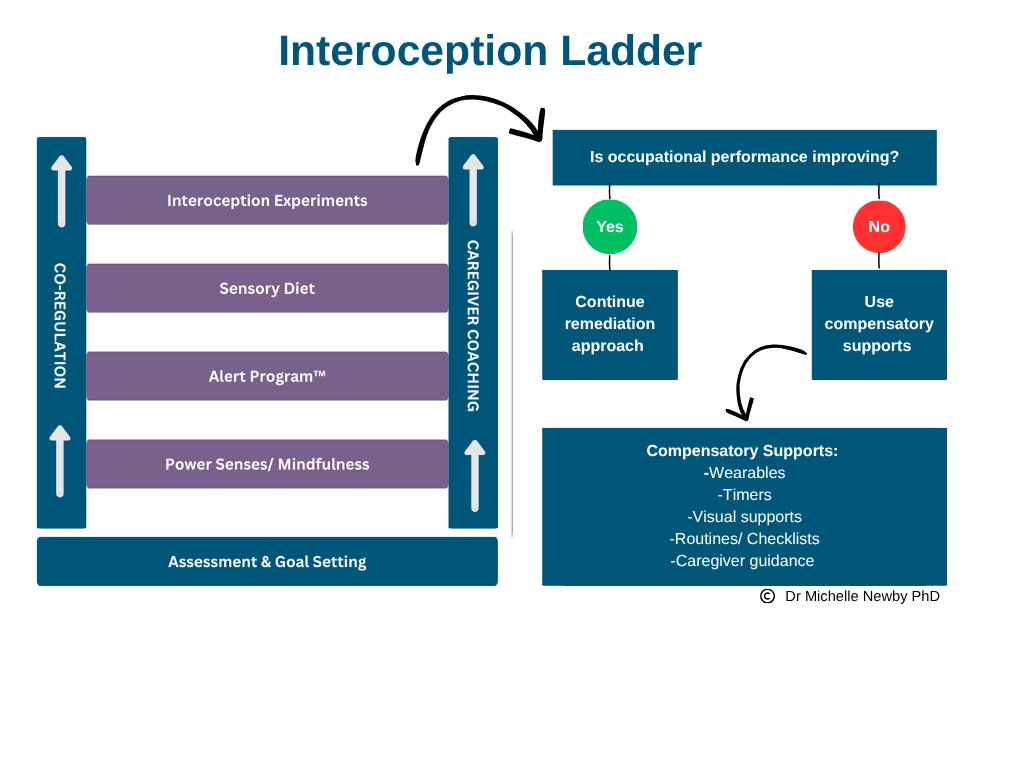
Tuning In: Supporting Interoceptive Awareness in Neurodiverse Children
Reference list:
Adams, K. L., Murphy, J., Catmur, C., & Bird, G. (2022). The role of interoception in the overlap between eating disorders and autism: Methodological considerations. European Eating Disorders Review, 30(5), 501–509.
Arnold, A. J., Winkielman, P., & Dobkins, K. (2019). Interoception and social connection. Frontiers in Psychology, 10, 2589.
Berntson, G. G., & Khalsa, S. S. (2021). Neural circuits of interoception. Trends in Neurosciences, 44(1), 17–28.
Clark, R., Janssen, N., & Wilson, N. J. (2025). Interoception and occupational therapy: A scoping review. Australian Occupational Therapy Journal, 72(1), 5–23.
Critchley, H. D., & Garfinkel, S. N. (2017). Interoception and emotion. Current Opinion in Psychology, 17, 7–14.
Government of South Australia. (2019). Ready to learn: Interoception kit. Government of South Australia. https:// www.education.sa.gov.au/docs/support-and-inclusion/ engagement-and-wellbeing/ready-to-learn-interoceptionkit.pdf
Janssen, H. L. (2022). Interoception toolkit: A resource for occupational therapy practitioners to use with children and their families. University of North Dakota.
Mahler, K. (2016). The comprehensive assessment of interoceptive awareness. Mahler Autism Services
Mahler, K. (2019). The Interoception Curriculum: A step-by-step guide to developing mindful self-regulation. Mahler Autism Services.
Schaan, V. K., Schulz, A., Rubel, J. A., Bernstein, M., Domes, G., Schächinger, H., & Vögele, C. (2019). Childhood trauma affects stress-related interoceptive accuracy. Frontiers in Psychiatry, 10, 750.
Schmitt, C. M., & Schoen, S. (2021). Interoception: A multi-sensory foundation of participation in daily life. Frontiers in Neuroscience, 16, Article 875200.
Suksasilp, C., & Garfinkel, S. N. (2022). Towards a comprehensive assessment of interoception in a multi-dimensional framework. Biological Psychology, 169, 108296.
Tsakiris, M., & Critchley, H. (2016). Interoception beyond homeostasis: Affect, cognition and mental health. Philosophical Transactions of the Royal Society B: Biological Sciences, 371(1708), 20160002.
Tsutsumi, Y., Tachibana, Y., Sato, F., Furuta, T., Ohara, H., Tomita, A., Fujita, M., Moritani, M., & Yoshida, A. (2018). Cortical and subcortical projections from granular insular cortex receiving orofacial proprioception. Neuroscience, 388, 317–329.
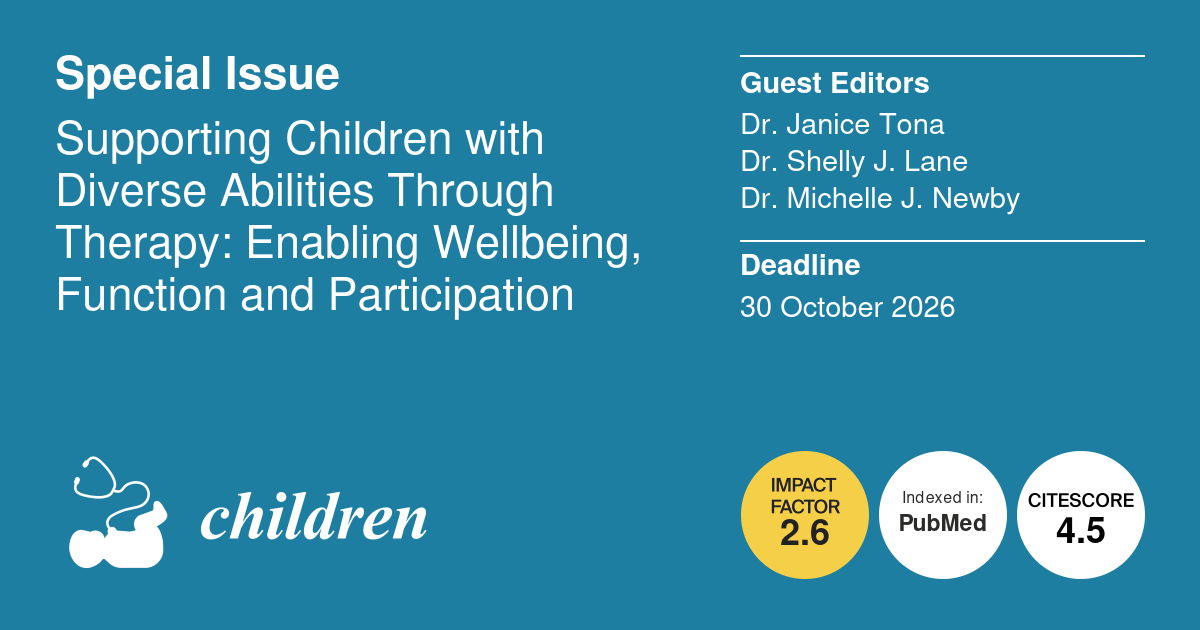
Submit your research to our Special Issue
We are inviting submissions for the Children Special Issue:
Supporting Children with Diverse Abilities Through Therapy: Enabling Wellbeing, Function and Participation.
This issue will showcase high-quality research exploring how therapy supports children’s participation, everyday functioning, and wellbeing across diverse developmental, health, and disability contexts.
Children is a Q1, PubMed-indexed journal with a 2025 CiteScore of 4.5.
Guest edited by Dr Janice Tona, Dr Shelly J. Lane, and Dr Michelle J. Newby.
Submission deadline: 30 October 2026
Find Out More